28 Sep SustainaBlue project marks 3 years of impactful milestones
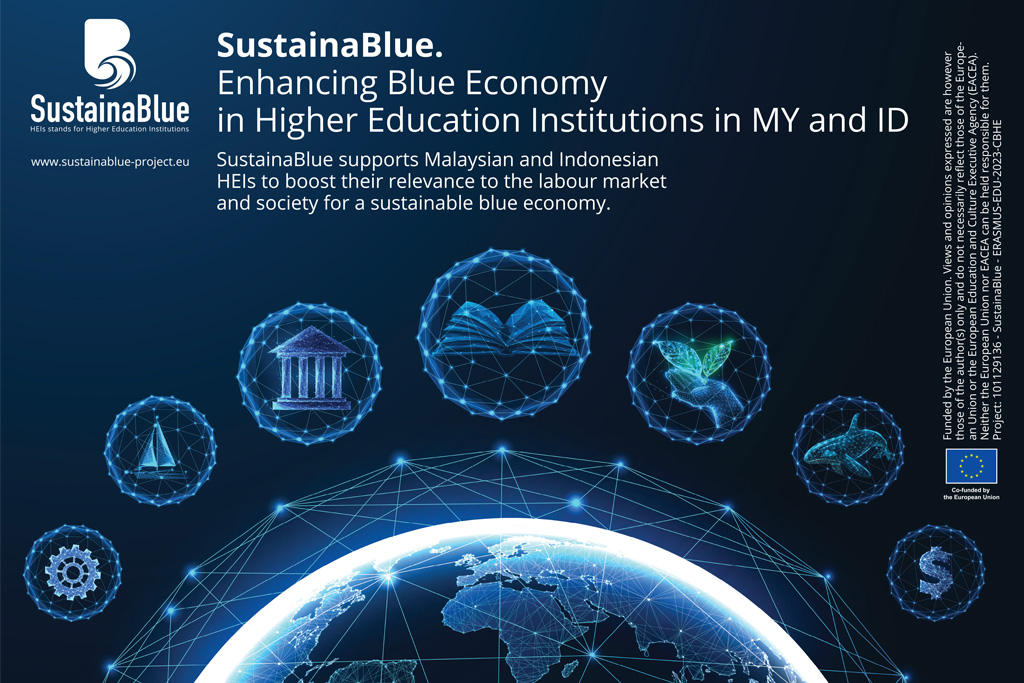
Having completed three years of intensive collaboration between 11 international partners, the SustainaBlue project has achieved its key milestones, creating strong collaboration frameworks, Sustainable Blue Economy Centers, digital tools and capacity building programs to strengthen the sustainable blue economy in Malaysia and Indonesia.
Co-funded by the European Union’s Erasmus+ program, SustainaBlue adopts the Quintuple Helix model, supporting an innovative approach that unites academia, industry, government, civil society and the environment in a shared mission to cultivate a sustainable blue economy.
Since the launch of the SustainaBlue project, the consortium has achieved all key milestones with significant impact. By collecting successful Quintuple Helix frameworks from EU member states and developing relevant recommendations, it has facilitated their effective adaptation to Asian socio-economic contexts. Within this framework, it has established fully equipped in-house Sustainable Blue Economy Centers (SBECs) across the four collaborating Asian HEIs in Malaysia and Indonesia. The SBECs driven by a common framework, clear mandates and annual action plans, function as hubs for cooperation, co-creation, and co-production of knowledge and innovation between HEIs, blue industries, local authorities and relevant stakeholders. These cross-sectoral collaborations are promoted and enhanced by mapping and establishing collaboration networks with relevant ecosystem stakeholders based on signed MoUs.
A major milestone in the project’s effectiveness and advancement of its goals was the creation of the Blue & Green Acceleration Platform, a dynamic digital hub, a growing digital community, designed to connect knowledge with people, opportunities and real-world experience, bringing together Higher Education Institutions, industry, government, civil society and the environment to strengthen collaboration and innovation across the blue and green economy.
In parallel, the project conducted extensive labor market studies identifying key technical, digital and green skills gaps in Malaysia and Indonesia. The output is an extensive report on skills needs in sectors of the sustainable blue economy, providing suggestions for enhanced digital skill programs, increased vocational training, and closer ties between the education sector and industry. Through these recommendations, Malaysia and Indonesia will be able to develop a workforce that is competitive, talented, and prepared for the future.
The successful implementation of the program and its milestones was accompanied by comprehensive capacity-building programs for the academic and administrative staff of the four Asian HEIs. Through targeted modules, webinars, workshops and an online ToT (Training of Trainers) program, the aim was to promote knowledge and develop skills for the effective development and maintenance of collaboration frameworks, as well as to equip the academic staff with the knowledge, skills, and tools necessary to design innovative curricula for green and blue skills education.
Three years after the launch of the program, and with all deliverables set to be completed by the end of the year, it is clear that every end is truly a new beginning. The program has laid the groundwork to maximize these results in the coming years, unlocking new opportunities for the future.